
Audit Overview
Your store's untapped revenue potential — and how to unlock it
Why We Created This Audit
We analyzed https://www.khazanajewellery.com/ the same way we've audited 350+ e-commerce stores — looking for the specific gaps between your current experience and what top-performing Jewelry & Accessories stores deliver. Every finding in this report is a revenue opportunity backed by industry data and competitive benchmarks.
What We Analyzed
- UX & Conversion Design14 findings
- Technology & App StackPlatform + 4 apps
- Industry BenchmarksJewelry & Accessories
Pages Analyzed
- Homepage4 findings
- Collection Pages2 findings
- Product Pages (PDP)6 findings
- Cart & Checkout2 findings
 This audit was prepared by Growisto — a CRO-led Website development team behind 167% conversion growth for Atomberg, 46% CR lift for TyresNmore, and 350+ e-commerce projects.
UX & Conversion Findings
Page-by-page analysis with visual comparisons against top Jewelry & Accessories stores
- Khazana's homepage hero rotates generic lifestyle imagery without occasion-specific messaging or CTAs.
- Top South Indian jewelry brands run dedicated campaign heroes tied to Akshaya Tritiya, Diwali, Wedding Season, and Dhanteras — each with a distinct headline, offer, and CTA.
- Occasion-specific heroes capture intent at the highest-traffic moments of the jewelry calendar, where purchase probability is 3–5× baseline.
- 6 out of 10 top India jewelry stores in our benchmark run at least one occasion-specific hero at any given time.
- Build a campaign hero slot (separate from the evergreen hero carousel) for festive and bridal season pushes with a dedicated CTA like 'Explore Bridal Collections' or 'Akshaya Tritiya Gifts'.
- Plan occasion hero content 4–6 weeks ahead of major Indian jewelry gifting events: Akshaya Tritiya, Diwali, Dhanteras, wedding season (Nov–Feb), Valentine's Day.
- A/B test occasion-hero click-through vs. generic hero to quantify the uplift for your audience.
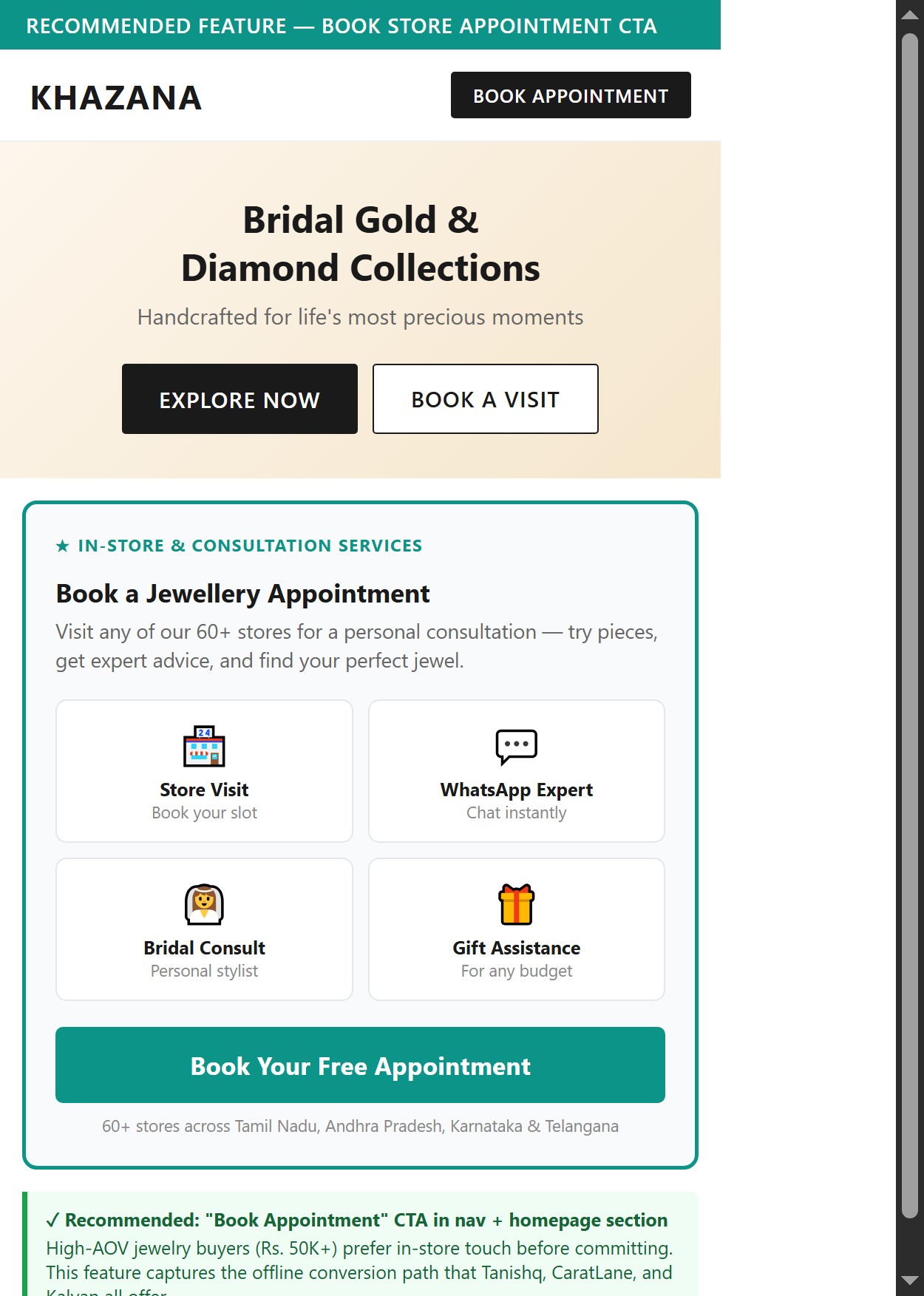
- High-AOV jewelry purchases (especially gold, diamond, bridal sets above Rs. 50,000) often require in-store touch, sizing, or consultation before commitment.
- Khazana operates 60+ stores across South India — this physical presence is a major competitive advantage, but the website provides no way to engage with it.
- Tanishq, CaratLane, and Kalyan all feature visible 'Book Appointment' or 'Try at Store' CTAs on the homepage, directing high-intent visitors to a low-friction offline path.
- 2 of 5 top India stores benchmark this as a differentiator that converts high-AOV browse sessions that would otherwise bounce.
- Add a persistent 'Book a Store Visit' or 'Consult Our Experts' CTA in the navigation bar and/or as a homepage section, linking to a store locator + appointment booking flow.
- For bridal or high-value purchases, offer a 'Personal Jewellery Consultation' CTA that collects name, phone, preferred store, and occasion — captured leads can be followed up by store staff.
- Implement a WhatsApp 'Chat with a Jewellery Expert' entry on mobile (common in India DTC), which reduces friction vs. a full booking form.

- CrUX field data (28-day average of real Chrome users) shows CLS = 0.38 on mobile — far above the Google 'Good' threshold of 0.10.
- CLS causes visible content shifts: hero images, price labels, and CTA buttons jump position as web fonts load and BunnyCDN assets arrive, visibly disrupting the reading flow.
- Google uses CWV (including CLS) as a ranking signal — Khazana's mobile pages are penalised in search rankings vs. competitors who pass CWV.
- Desktop CLS is 0.02 (Good), indicating the root cause is likely missing width/height attributes or CSS aspect-ratio declarations on mobile-specific image slots rather than a sitewide layout bug.
- Tanishq and other competitors also fail CWV, so fixing CLS would make Khazana a mobile performance leader in the South India jewelry segment.
- Audit all
tags on the homepage and PDP for missing width/height attributes — adding explicit dimensions lets the browser reserve space before images load, eliminating the largest source of layout shift.
- Add CSS aspect-ratio: 16/9 (or correct ratio) to hero image containers so the slot holds its dimensions while the image fetches from BunnyCDN.
- Defer or async-load any web fonts that cause FOIT/FOUT — use font-display: swap and preload the primary font file.
- Re-measure CLS in PageSpeed Insights after each fix using the 'Field Data' section; target CLS < 0.10 to pass Core Web Vitals.
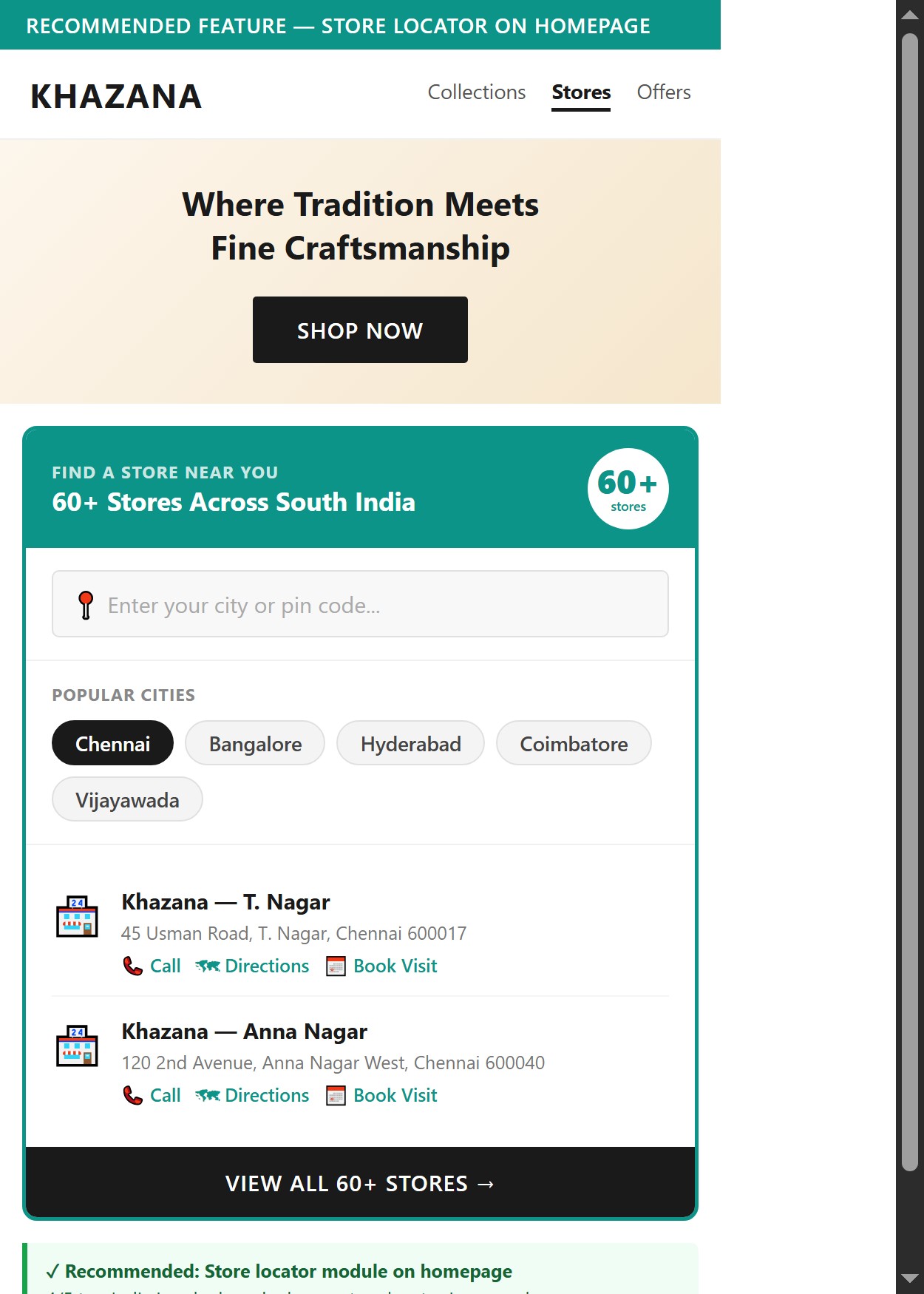
- Khazana has 60+ stores across Tamil Nadu, Andhra Pradesh, Karnataka, and Telangana — a scale that signals brand legitimacy and reduces purchase risk for high-AOV buyers.
- New visitors unfamiliar with the brand have no visible signal of this retail depth on the homepage — no store count badge, no 'Find a Store Near You' CTA, no city/region selector.
- 4 of 5 top India jewelry brands feature a store locator link in the primary navigation or as a homepage section.
- Jewelry buyers who know they can visit a store before or after purchase have 30–50% higher conversion rates on high-AOV items compared to pure-play online-only stores.
- Add a 'Find a Store' link in the top navigation bar (standard across all major India jewelry e-commerce sites).
- Include a homepage section (below the hero or before the footer) showing a map snippet or city-grid of key store locations with a 'View All 60+ Stores' CTA.
- On the store locator page, enable GPS-based detection and show each store's hours, contact number, and featured product categories available in-store.
- Khazana's collection pages display a grid of products with no visible filter panel — visitors must scroll through all products to find items matching their budget, metal preference, or occasion.
- Jewelry buying intent is highly specific: 'rose gold earrings under Rs. 15,000 for a wedding' — without filters, the shopper must scan hundreds of cards or abandon.
- CaratLane's collection pages offer faceted filters for metal type (gold/platinum/silver), purity (22kt/18kt), stone (diamond/emerald/ruby), occasion (wedding/casual/office), and price bands — industry leading.
- 5 of 10 top jewelry stores in our benchmark offer collection filters; among India-specific stores, this is increasingly expected by fashion-forward urban buyers.
- Missing filters inflate bounce rates on collection pages and suppress ATC rates — a key lever at the p50 ATC benchmark of 6% for jewelry.
- Implement a left-rail or top-bar filter panel on all collection pages with: metal type, gold purity (22kt/18kt/14kt), price range (slider), stone type, occasion, and gender.
- Add active filter chips so shoppers can see and remove applied filters without navigating away.
- Persist filter state in the URL (query params) for shareability and Google indexing of filtered collection pages (valuable for SEO on long-tail jewelry queries).
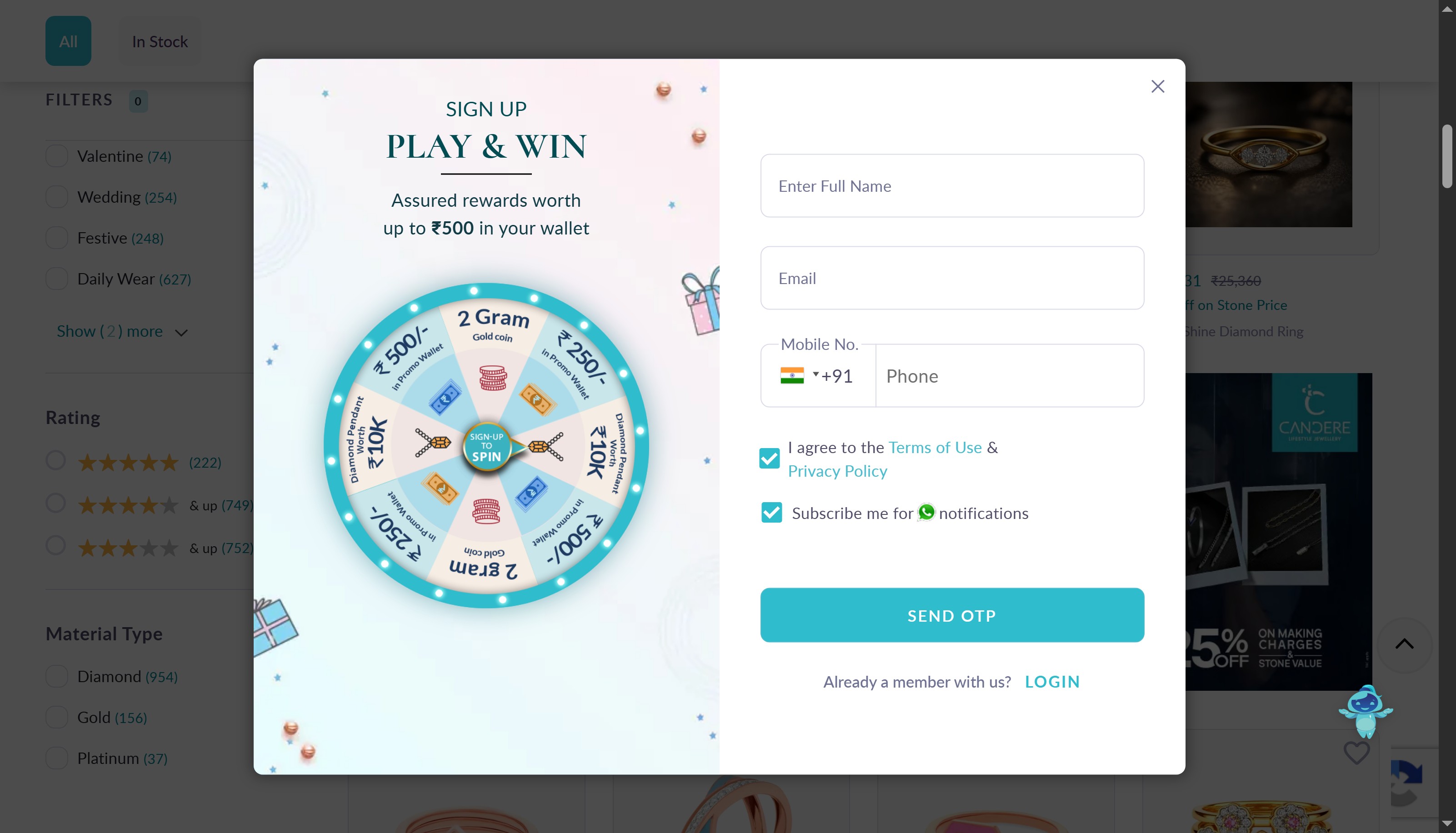
- Khazana product cards show product image, name, and price — no rating count or star score is visible at the collection browse stage.
- Star ratings on collection cards act as social proof shorthand, allowing shoppers to quickly identify popular or well-reviewed pieces without clicking into each PDP.
- 5 of 10 top jewelry stores in our benchmark show aggregate ratings on product cards; CaratLane and Kalyan both display star scores in collection grids.
- For jewelry — where product quality and craftsmanship cannot be physically assessed — ratings at browse stage disproportionately influence which products receive PDP visits.
- Display aggregate star rating and review count on every product card that has at least one review (e.g., ★ 4.3 (128)).
- For new products without reviews, surface a 'New' badge rather than showing an empty rating slot.
- This requires implementing a reviews system first (see PDP_F1) — ratings on collection cards should follow automatically once PDP-level reviews are captured.
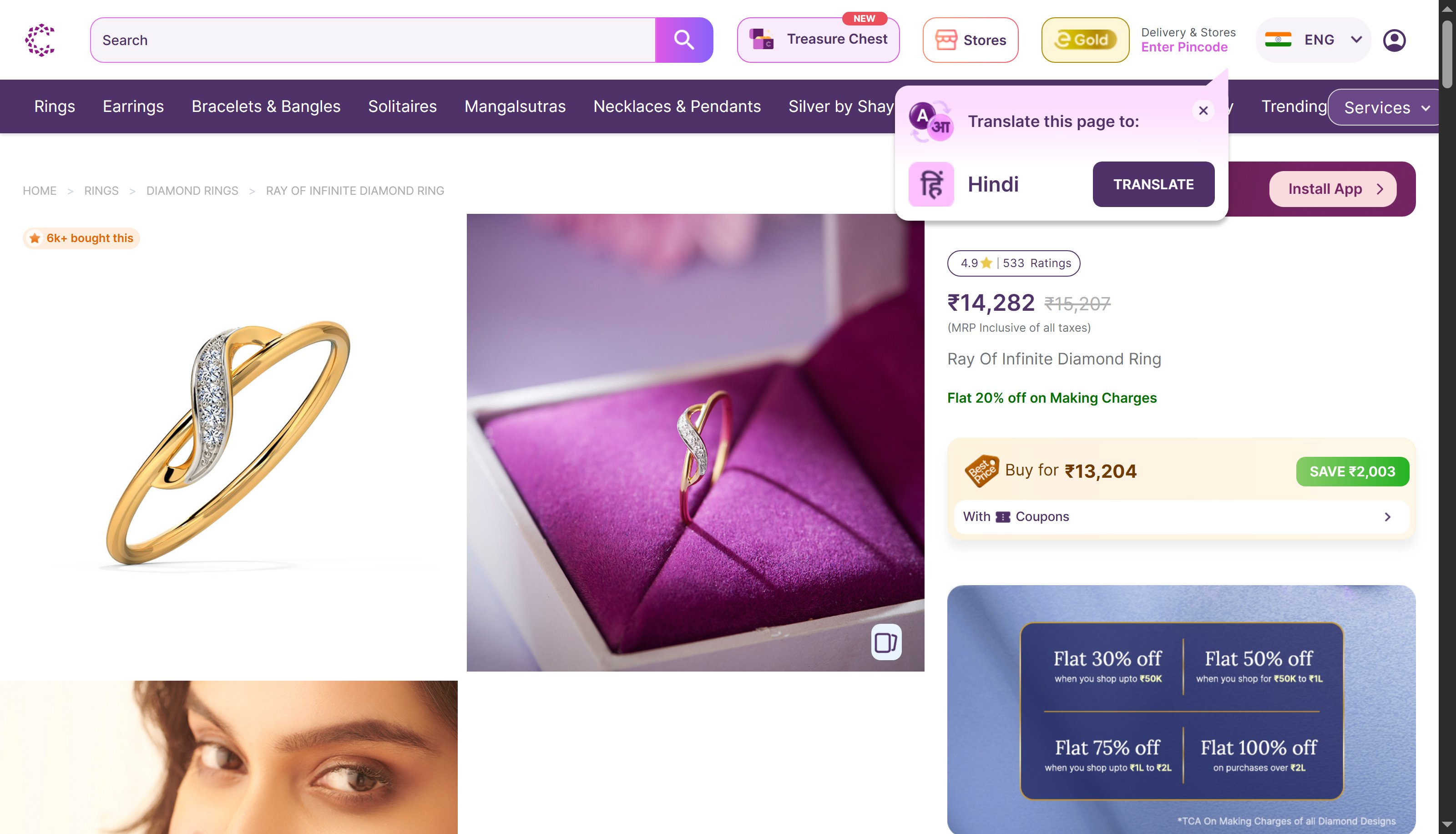
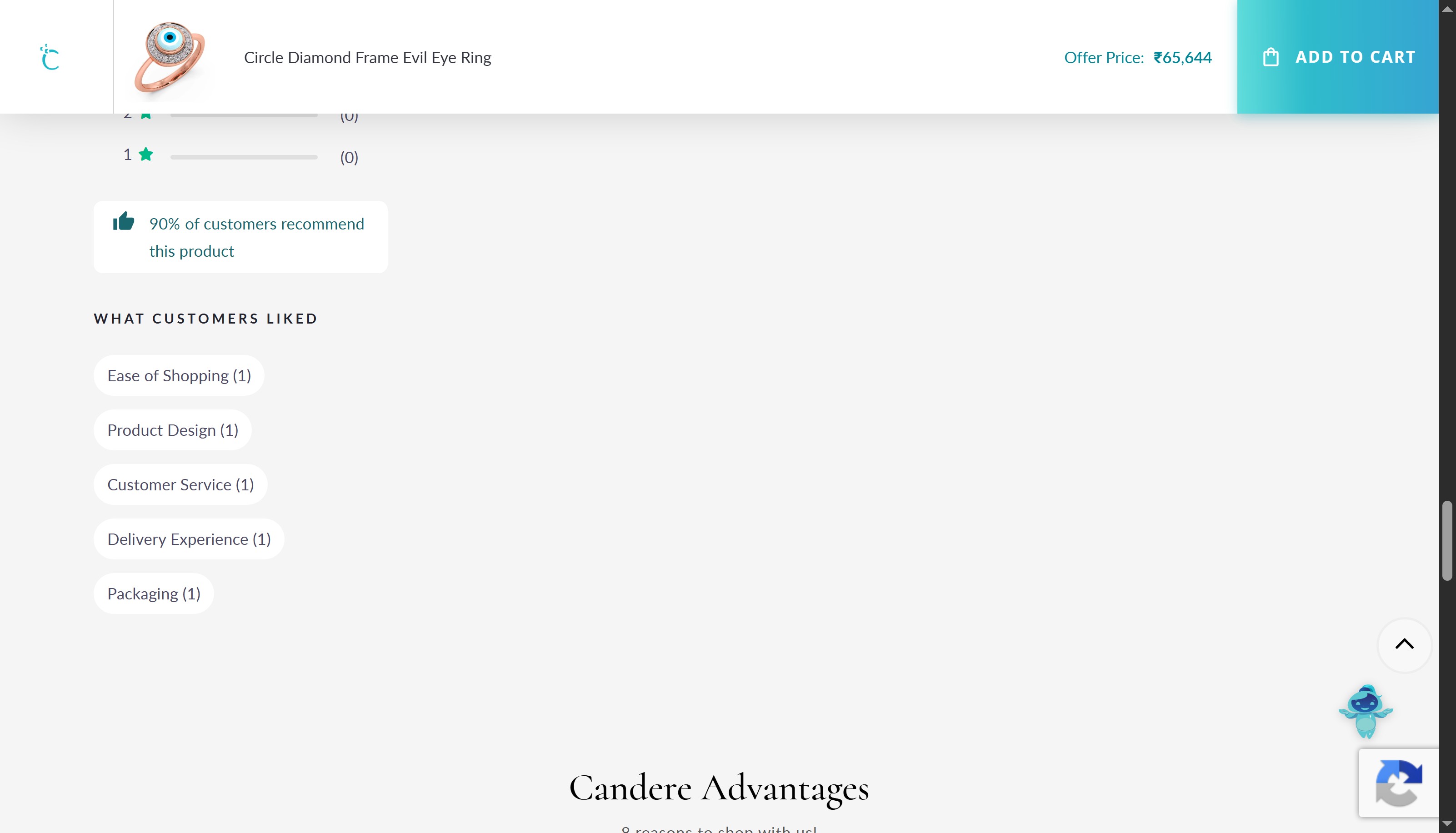
- Khazana PDPs contain product description, weight, metal specs, and price — but no customer reviews, star ratings, or photo review section.
- For mid-to-premium jewelry (Rs. 5,000–1,00,000), purchase confidence depends heavily on peer validation — buyers want to know how the piece looks in real life and if the quality matches the description.
- 5 of 10 top jewelry stores in our benchmark display reviews on PDPs; CaratLane leads with both text reviews and photo reviews embedded below the product images.
- Reviews reduce perceived purchase risk, increase average order value, and reduce returns — for jewelry brands, photo reviews showing the item being worn are particularly high-impact.
- The absence of reviews makes Khazana PDPs feel thin vs. competitors and lowers conversion especially on new or unfamiliar product lines.
- Implement a product reviews app (e.g., Yotpo, Judge.me, Okendo) that captures text reviews, star ratings, and photo/video uploads from verified buyers.
- Send automated post-purchase review request emails at 7 and 14 days after delivery — incentivise with a loyalty point reward for submitted reviews.
- Display aggregate rating prominently below the product title (not buried at page bottom), with a review count that links to the review section.
- Enable photo reviews prominently — real customer photos of jewelry being worn are the highest-converting social proof for this category.
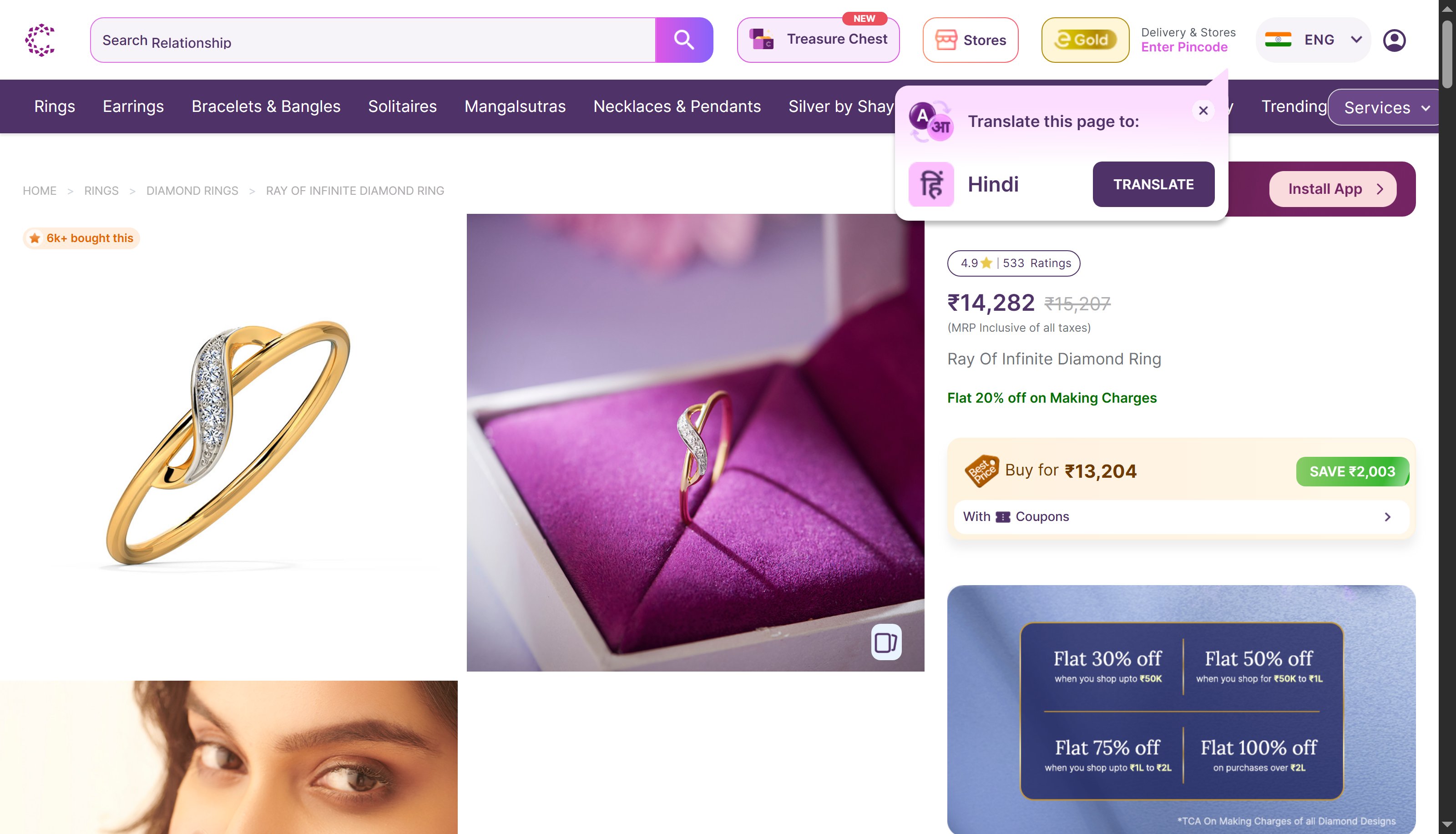
- Khazana's PDPs show a full price only — no mention of EMI, no-cost EMI, or monthly instalment options beneath the price.
- For items priced above Rs. 10,000, the full price shown without EMI context creates a price shock moment that suppresses 'Add to Cart' clicks.
- CaratLane prominently shows 'No-cost EMI from Rs. X/month' directly below the price on every PDP, normalising the price point and reducing abandonment at the browse stage.
- 4 of 10 top jewelry stores display EMI options at the PDP level; for India's high-AOV jewelry segment, this is increasingly a table-stakes trust feature.
- Khazana reportedly offers EMI at checkout (per site FAQ), but surfacing this at PDP level is where the conversion lift occurs — price anchoring at the decision moment.
- Add an EMI calculator widget or static 'No-cost EMI from Rs. X/month on orders above Rs. 10,000' line directly below the price on all PDPs.
- Integrate with Simpl, LazyPay, or Razorpay BNPL to show real-time EMI options with partner bank logos (increases credibility).
- For items above Rs. 50,000, display a dedicated EMI options accordion showing 3/6/9/12-month tenures and monthly amounts.
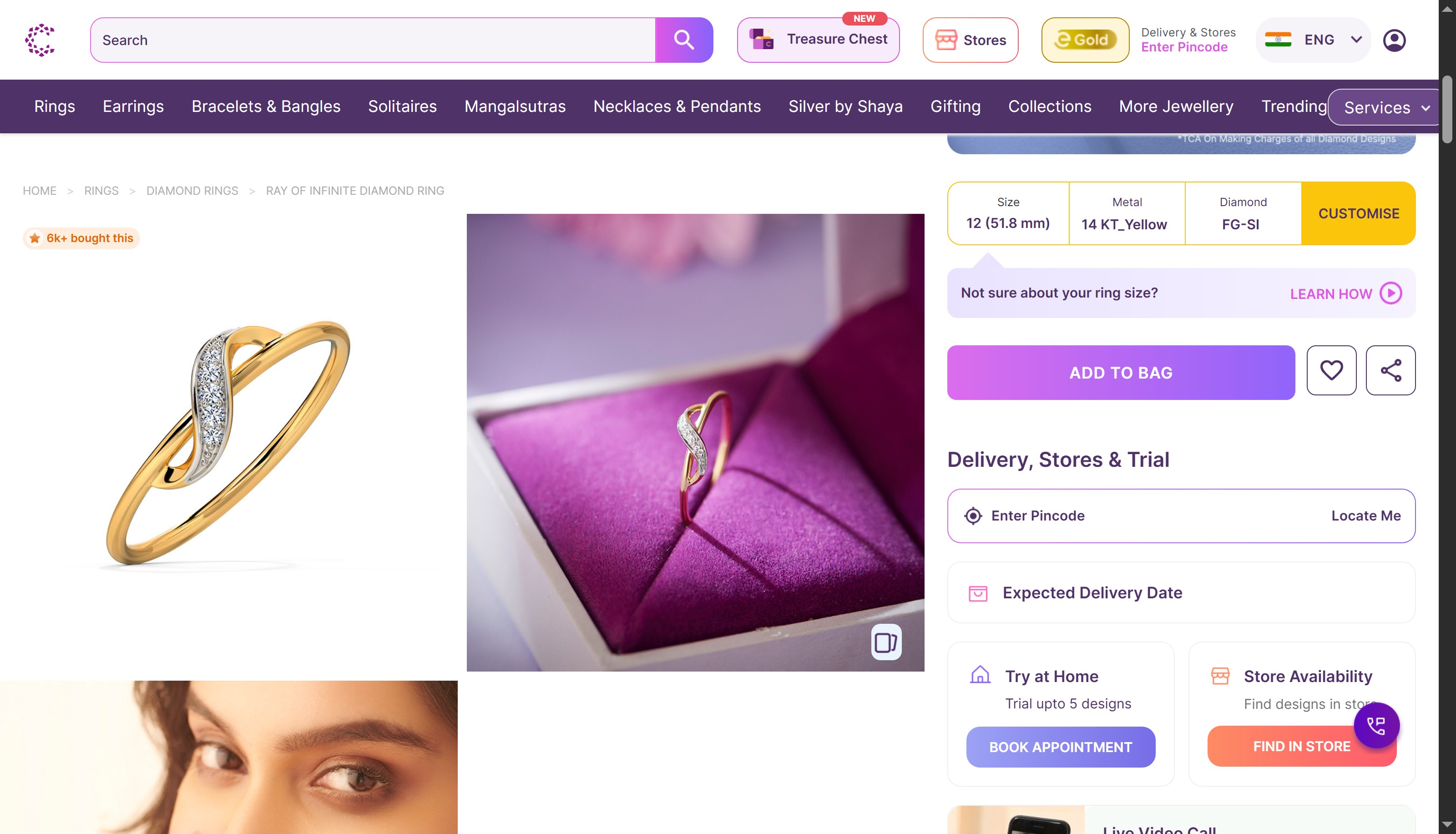
- Khazana PDPs show 2–4 static product images — no zoom-on-hover, no 360° spin view, and no product video.
- Jewelry purchases are driven by visual inspection of fine details: stone clarity, setting quality, finish texture, and how the piece moves. Static images cannot convey this.
- 7 of 10 top jewelry stores globally offer high-res zoom; 3 of 10 offer 360° spin or video. In India, CaratLane's detailed video walkthroughs are a key differentiator.
- Absence of detailed imagery is a documented cause of jewelry returns — buyers receive products that look different than expected from flat photos.
- Even without 360° technology, adding a 4–8 second product video shot from multiple angles (ring rotating on a hand, necklace against skin) dramatically increases buyer confidence.
- Implement high-res zoom on hover/pinch for all product images (minimum 1600×1600px source images), using a lightbox for mobile.
- For key SKUs (above Rs. 20,000), produce short 5–10 second product spin videos shot on a jewellery turntable — these can be uploaded as an additional media slot on the PDP.
- As a faster win: add at least 6 images per PDP showing different angles — front, side, clasp detail, in-hand scale, and lifestyle shot.
- Long-term: consider AR try-on integration (used by CaratLane) — currently a differentiator but rapidly becoming expected in the 25–40 demographic.
- Khazana PDPs offer 'Add to Cart' as the only conversion action — there is no 'Try at Home', 'Try at Store', or 'Book Appointment to View' option.
- For high-value jewelry (rings, bangles, necklaces above Rs. 30,000), buyers often want to physically try before committing — without a pathway to do so, many bounce.
- CaratLane's 'Try at Home' programme (available in metro cities) is a major conversion driver; Kalyan offers 'Try at Store' appointment booking from PDPs; Tanishq offers consultation booking.
- 3 of 5 top India jewelry stores provide this CTA — Khazana's 60+ store network makes it uniquely positioned to offer this but the website provides no entry point.
- Even a simple 'WhatsApp us to try this piece at your nearest Khazana store' button would capture this intent without complex tech infrastructure.
- Add a 'Try at Your Nearest Store' secondary CTA below the 'Add to Cart' button, linking to the store locator pre-filtered to the visitor's region.
- For metro cities (Chennai, Bangalore, Hyderabad), explore a 'Try at Home' pilot with a WhatsApp form to capture name, phone, address, and preferred time slot.
- Add a product-sharing CTA ('Share with Family for Gifting') that generates a WhatsApp-shareable product link with the price and image — supports the common India pattern of group gifting decisions.
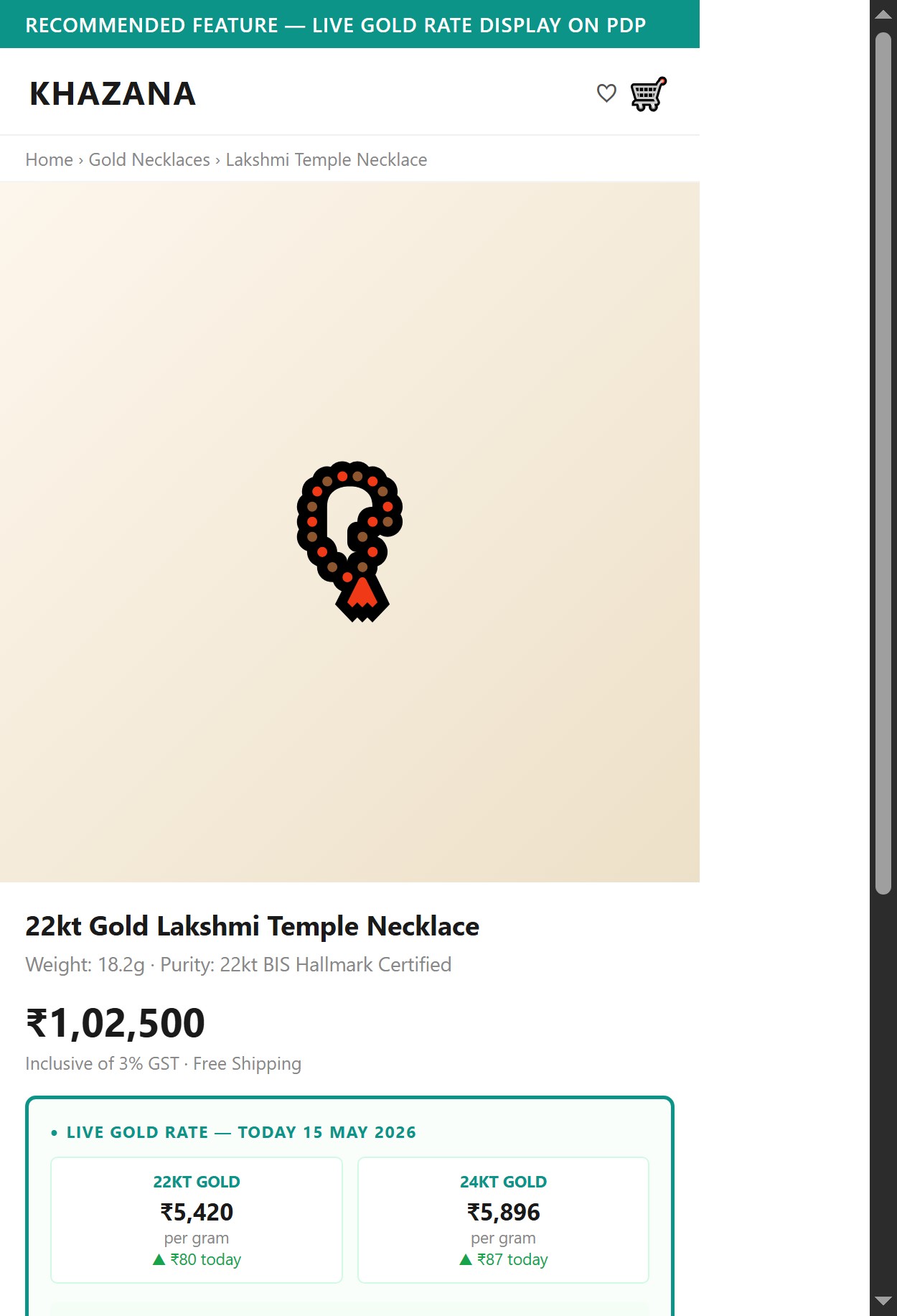
- Khazana gold jewelry PDPs show total price but do not display the current gold rate (Rs./gram for 22kt or 24kt) or a breakdown of gold weight × rate + making charges.
- Serious gold jewelry buyers in India track daily gold rates (MCX/IBJA) and use them to evaluate whether the current price is fair — this is a deeply ingrained purchasing behaviour.
- Tanishq is the only major brand to display a live gold rate ticker on its website — this creates pricing transparency that directly differentiates them from competitors who obscure the rate.
- Publishing gold weight + making charges + live gold rate signals confidence in pricing fairness and reduces negotiation anxiety for first-time online buyers.
- This feature is especially relevant for Khazana's South Indian core market, where gold buying is closely tied to commodity price awareness.
- Add a 'Today's Gold Rate' widget to gold jewelry PDPs showing the current 22kt and 24kt rate per gram (sourced from IBJA or MCX daily update), refreshed once daily.
- Show a price breakdown: Gold weight (e.g., 8.2g) × Gold rate + Making charges + GST = Total price. This transparency is rare and builds outsized trust.
- Link the gold rate widget to a 'Gold Rate History' page to add educational content and capture intent from visitors researching gold investment.
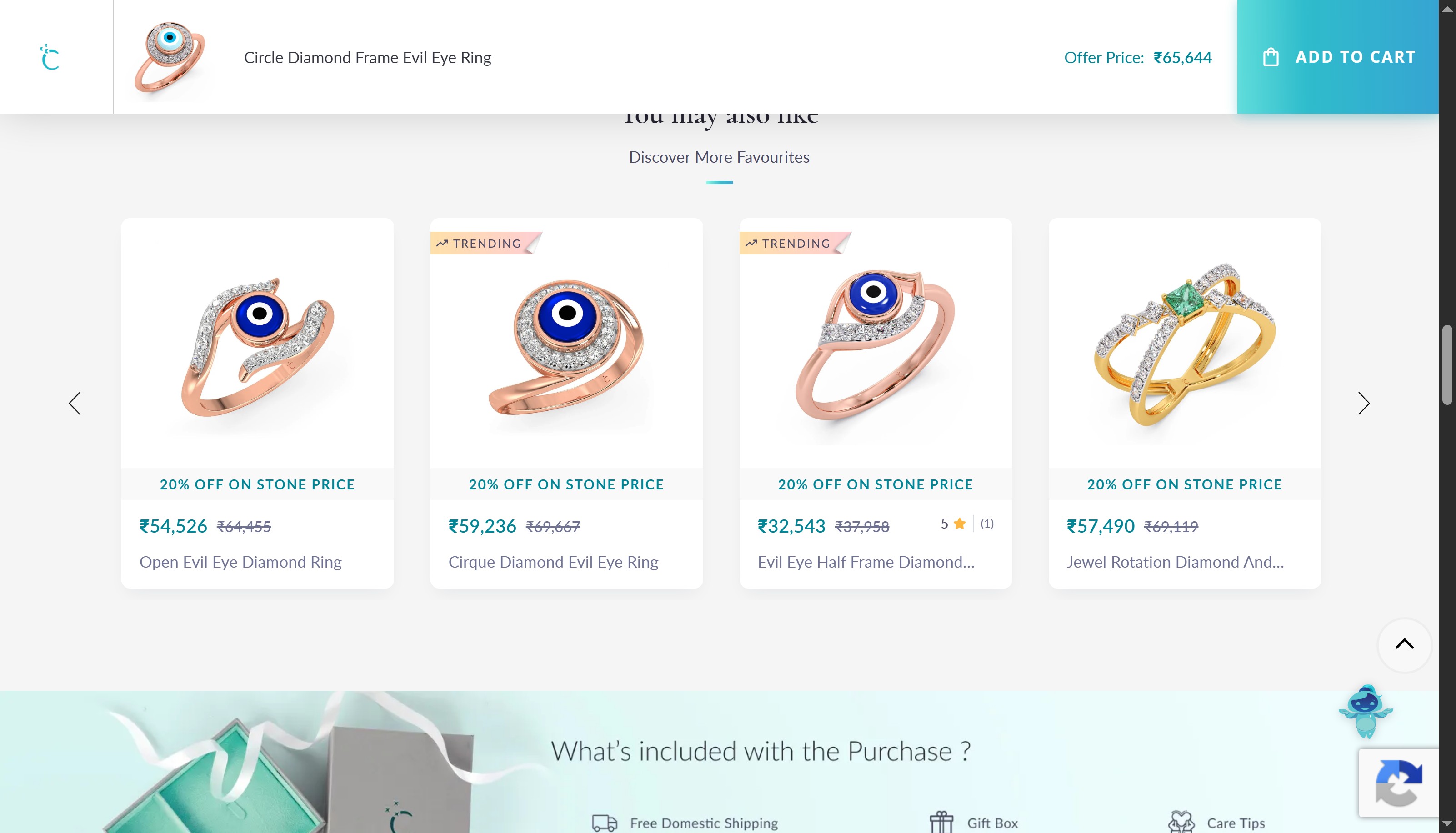
- Khazana PDPs show product details and end without any 'You may also like', 'Complete the Look', or 'Shop the Set' recommendations.
- Jewelry is naturally complementary — earrings pair with necklaces, bangles with rings, sets with matching accessories — making it an ideal category for cross-sell.
- 4 of 10 top jewelry stores in our benchmark include a cross-sell section on PDPs; Kalyan highlights 'Complete the Set' for matching jewellery pieces.
- A 'Complete the Look' section combining earrings + necklace + bangles on a bridal PDP can significantly lift average order value through natural set bundling.
- Without cross-sell, Khazana misses the opportunity to increase basket size from visitors who arrived with intent to buy one item but could be upsold a complementary piece.
- Add a 'Complete the Look' section below the product description showing 3–4 complementary pieces (same metal, same occasion, same collection).
- For sets and suites (necklace + earring + bangle sets), add a 'Buy the Full Set' option with the combined price and a small set-discount incentive.
- Add a 'Recently Viewed' section at PDP bottom to help returning visitors resume their browsing session.
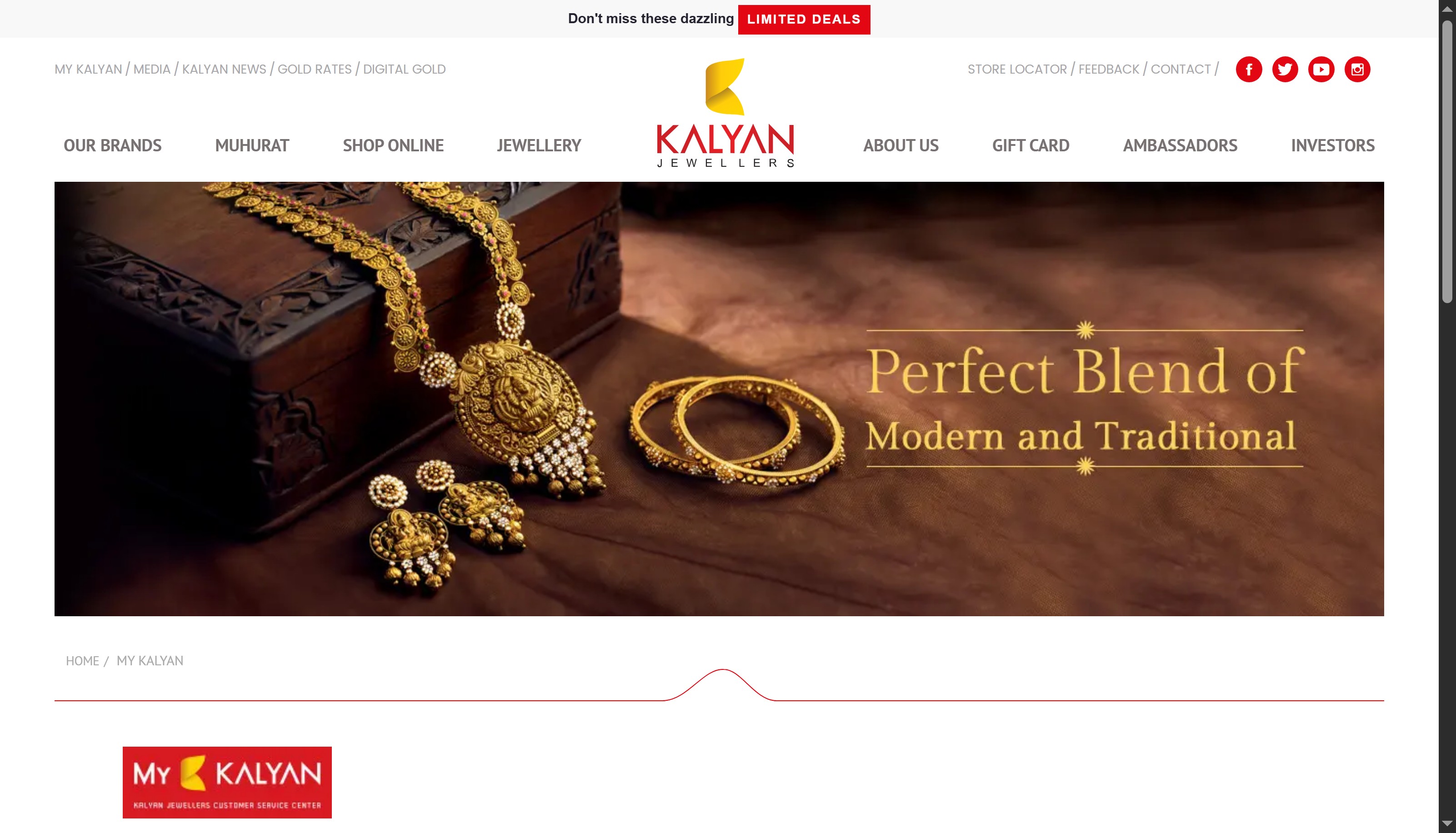
- Khazana's cart and checkout have no loyalty programme prompts, points display, or member sign-up incentive.
- 3 of 10 top jewelry stores in our benchmark operate loyalty programmes; Tanishq's Golden Harvest scheme and Kalyan's loyalty points are key retention drivers.
- For jewelry brands, repeat purchase rate is a critical LTV driver — bridal buyers return for anniversary gifts, family purchases, and festival buying if rewarded.
- The cart is the highest-intent moment on the site — a loyalty prompt ('Join Khazana Rewards: earn points on this purchase') at cart converts impulse sign-ups that email campaigns cannot.
- Khazana's 60+ store network provides a natural loyalty touchpoint — online and in-store earning and redemption would create a phygital loyalty loop uncommon among competitors.
- Launch a Khazana Rewards programme with a simple earn structure: X points per Rs. 1,000 spent, redeemable as discount on next purchase.
- Display a loyalty signup nudge in the cart: 'Join Khazana Rewards — earn [X] points worth Rs. [Y] on this order.'
- Offer a first-order joining bonus (e.g., 500 points = Rs. 500 off) to drive programme adoption among first-time buyers.
- Enable phygital earning: points earned in-store can be redeemed online and vice versa, leveraging Khazana's store network as a loyalty differentiator.
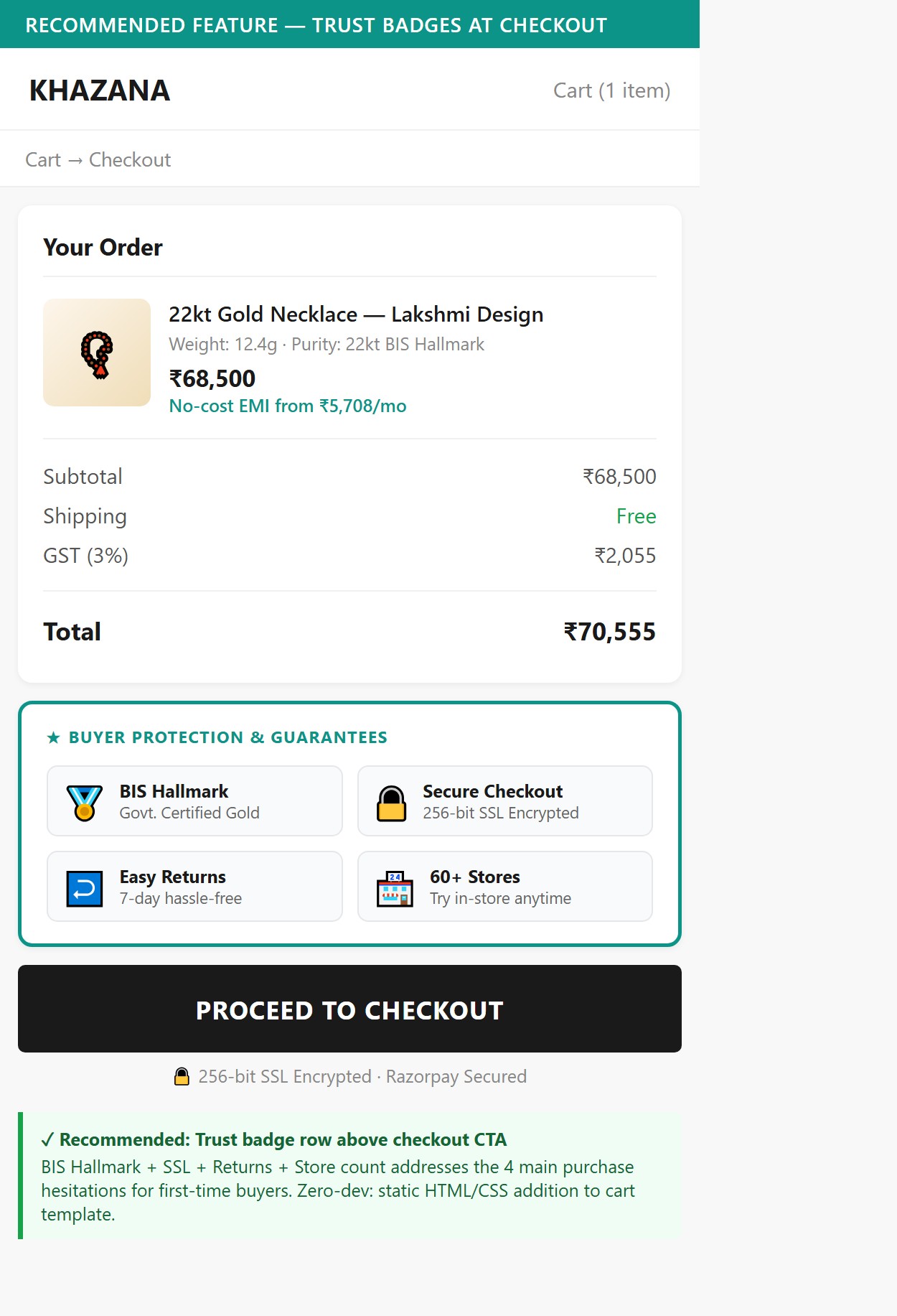
- Khazana's cart page shows order summary, price breakdown, and a checkout button — but no trust reassurances are visible near the CTA.
- Last-moment checkout hesitation in India is often triggered by: payment security concerns, authenticity doubts, and return policy uncertainty — especially for first-time buyers.
- 5 of 10 top jewelry stores display a row of trust badges near the checkout CTA: BIS Hallmark certified, Secure Checkout (SSL), Free Returns, and EMI available.
- For jewelry specifically, a 'BIS Hallmark Certified' badge at checkout is a powerful purchase trigger — BIS certification is a regulatory trust mark that consumers increasingly demand.
- Khazana does sell BIS-certified jewelry, but this credential is not communicated at the critical checkout moment.
- Add a 4-badge trust row above/below the 'Proceed to Checkout' button: BIS Hallmark Certified | Secure Payment | Easy 7-Day Returns | 60+ Stores Across India.
- Use visual badge icons (not text-only) — a padlock, hallmark symbol, and return arrow are universally recognised trust signals.
- Add a 'Secure Checkout' micro-copy line ('256-bit SSL encrypted • Razorpay secured') near the payment CTA to address payment security anxiety.
Performance & Technology
Core Web Vitals, page-speed signals, and the technology stack powering Khazana Jewellery
Core Web Vitals
Technology Stack
Performance & Technology Assessment
Mobile performance is needs work (—/100); desktop is needs work (—/100) on Custom PHP / WordPress. Page-speed and Core Web Vitals are increasingly load-bearing for SEO and conversion in this category — addressing the weakest vital first is the single highest-leverage technical improvement available.
PageSpeed vs Competitors
| Site | Mobile | Desktop |
|---|---|---|
| This site | — | — |
| Tanishq | 72 | 84 |
| CaratLane | — | — |
| Kalyan Jewellers | — | — |
Confidential — Prepared for Khazana Jewellery by Growisto | May 2026
Technology Ecosystem
Technology stack assessment — installed tools vs recommended additions for Custom PHP / WordPress stores
Present (4)
Missing (7)
App Stack Assessment
Khazana's app ecosystem is lean — 4 detected integrations covering security, CDN, customer support, and basic analytics. The most impactful missing capabilities are reviews (no social proof at PDPs), EMI display (price anxiety unaddressed on the page where it matters), and a loyalty programme (no repeat-purchase mechanism). The custom platform means implementation is costlier than for Shopify stores, but the conversion upside on these three alone — for a brand with 60+ stores and substantial organic traffic — is significant.
Confidential — Prepared for Khazana Jewellery by Growisto | May 2026